Keewatin Barren Lands
Never Cry WolfThe Keewatin Barren Lands are the central subarctic landscape in which Farley Mowat’s wolf study unfolds, and more than a remote backdrop, they are the place where competing accounts of wildlife and responsibility collide. Their tundra, lakes, eskers, rivers, and timberline routes shape how animals move and how people live. The region’s apparent emptiness is relative: during the study, a trapper named Mike was the only other human inhabitant within roughly ten thousand square miles, apart from an Indigenous community living about seventy miles to the north. Yet the land was connected to distant decisions, hunting markets, government policy, and human activity along the Caribou migration routes.
Landscape and the Study Base
Farley Mowat’s account begins by measuring the distance between his grandparents’ home in Oakville and the bottom of a wolf den in the Barren Lands. His assignment sends him north from Ottawa toward Churchill town and then by chartered aircraft to a site with a sufficient wolf population. The instructions specify a general direction and purpose, but leave the precise location to be found in the field. Mowat eventually establishes a base on lake ice, far from land, and later moves his work to Mike’s cabin, which offers a more practical permanent camp. The contrast between a formal research mandate and the improvised realities of remote fieldwork defines the setting from the outset.
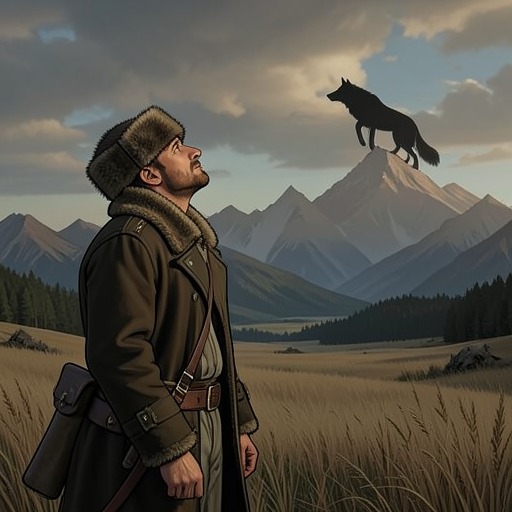
The open country makes observation difficult as well as expansive. At an esker where he suspects wolves have a den, Mowat chooses a rocky knoll about four hundred yards away and sets up a periscopic telescope, using the wind direction and the crest for concealment. He scans the sand and surrounding terrain for hours without seeing a wolf. The episode shows that remoteness does not grant the observer easy access: distances are large, cover is scarce, and the animals remain difficult to locate. The study depends on patience and on conditions the researcher cannot command.
Mike’s cabin makes clear how lightly settled the area is. Mike, an eighteen-year-old trapper of mixed Indigenous and white parentage, has lived in a territory where aircraft are rare enough that he initially struggles to account for Mowat’s arrival and equipment. His cabin is a few miles from the landing place, and the nearest Indigenous community is far to the north. This sparse settlement allows Mowat to regard the area as well suited to studying wolves without frequent human intrusion, but Mike’s own life also makes plain that people are already part of the region’s ecology.
Local Knowledge and Animal Movement
The Barren Lands are not described only through Mowat’s scientific plans. Ootek, who attaches himself to the wolf-observation work, brings local knowledge into the account. He regards wolves as relations and is keenly interested in them; as a child, he says, his father took him to a den, where he spent a day among wolf pups without being harmed by the adult animals. Mowat does not treat every report as established fact, but says that when he could obtain independent proof of Ootek’s claims, Ootek was consistently right. The landscape thus becomes a meeting place between field observation and knowledge acquired through local experience, rather than a space understood by the researcher alone.
Ootek’s account of the relation between Wolves and Caribou also changes how Mowat reads the terrain. He presents the animals as closely linked, and tells a traditional story in which Caribou are a gift that sustains people. Mowat initially doubts the idea that wolves chiefly take sick or weak animals. Mike’s disclosure redirects the question from wolf predation to human demand: he says that he kills roughly two or three hundred Caribou a year to feed himself and fourteen dogs, and that other trappers also require Caribou to keep their dogs working. Mowat’s records identify eighteen hundred trappers across parts of Saskatchewan, Manitoba, and southern Keewatin within the herd’s winter range. Using deliberately reduced assumptions about both their number and their annual kills, he calculates that trappers might be taking 112,000 animals in a year. The figure cannot be used in his official reports, but the discrepancy between the trappers’ survey responses and Mike’s account exposes a substantial gap in the accepted explanation for the herd’s decline.
Movement across this country also carries information. According to Ootek, a wolf in the territory north of theirs relayed news that Caribou had begun moving south, including where the herd was; that wolf had received the report from another wolf farther away. George then passed the news on. Mowat treats the account skeptically, but Mike sets out on a two- or three-day journey to hunt on its strength. A river narrows offers another point where seasonal movement shapes human activity: an Indigenous family camps nearby so that its men can intercept Caribou crossing the river, using kayaks and short spears to obtain meat for winter. In the Barren Lands, animal routes organize both wolf communication, as understood by Ootek, and the practical plans of human hunters.
Seasonal Hardship and Ecological Change
The region’s seasonal cycles make its wildlife vulnerable to more than one pressure at a time. The account describes the Arctic lemming population as following a four-year cycle, with a sharp decline after its peak. In 1946, when lemmings were at the low point, much of the depleted Caribou herd also changed its migration and bypassed southern central Keewatin. The resulting shortage affected Indigenous people, foxes, and Wolves. Hunger weakened animals, and rabies that had been latent among foxes spread to Wolves as well. The episode makes the Barren Lands a place of linked fluctuations: a change in prey availability and a shift in migration combine to produce hardship across species.
Mowat’s broader account connects these local conditions to human intervention. In the winter, Wolves move with the Caribou into timber, where trappers resent their competition for prey and their tendency to spring fox traps. The book describes fear of wolves, economic competition, and government bounties as forces sustaining a campaign against them; bounties in the North ranged from ten to thirty dollars per wolf. One trapper along the Manitoba–Keewatin boundary collected bounty on 118 wolves in a winter, 107 of them young. Although the law required trapping or shooting, the account says that strychnine was spread over a broad area, killing foxes, wolverines, and other carnivores as well. The winter landscape is therefore not simply a refuge for wildlife: it is also the setting for concentrated trapping and indiscriminate poisoning.
The pressure extends beyond trapping. Mowat describes how aircraft and snowmobiles have made formerly inaccessible Canadian hunting grounds easier for large numbers of hunters to enter, and how the resulting reduction in big game has encouraged the accusation that Wolves are responsible. In one account of organized Caribou safaris, aircraft gather herds on lakes and hunters fire from the planes, with participants paying a thousand dollars for the trip and guaranteed antlers. The scene places new transport technology, commercial hunting, and official participation alongside the older subsistence and trapping practices found in the region. The Barren Lands are remote from settled centres, but not insulated from economic decisions made elsewhere.
Narrative Significance
The setting gives Mowat’s argument its evidence and its limits. Its distances allow close association with wildlife away from dense settlement, while its sparse population makes each human presence consequential: Mike’s dogs require Caribou, Indigenous families plan around crossings, and trappers work large territories. At the same time, the scale of the landscape complicates observation. Wolves can be hard to see, migration can bypass an area, and human killing may be scattered across enormous distances or obscured in official reports.
As a result, the Keewatin Barren Lands emerge as neither empty wilderness nor a simple contest between people and wolves. They are a changing ecological and political landscape in which subsistence, commercial hunting, scientific observation, local knowledge, and state-backed wolf control overlap. The setting makes visible the book’s central reversal: claims that wolves alone are destroying wildlife are tested against the human practices and policies operating across the same country.